About the author

Gonzalo Gomez
AI & Automation Specialist
I design AI-powered communication systems. My work focuses on voice agents, WhatsApp chatbots, AI assistants, and workflow automation built primarily on Twilio, n8n, and modern LLMs like OpenAI and Claude. Over the past 7 years, I've shipped 30+ automation projects handling 250k+ monthly interactions.
Subscribe to my newsletter
If you enjoy the content that I make, you can subscribe and receive insightful information through email. No spam is going to be sent, just updates about interesting posts or specialized content that I talk about.
Introduction
Outbound sales calls are one of the hardest channels to automate with AI.
Latency matters.
Costs compound fast.
Hallucinations are unacceptable.
And voice systems fail loudly when something breaks.
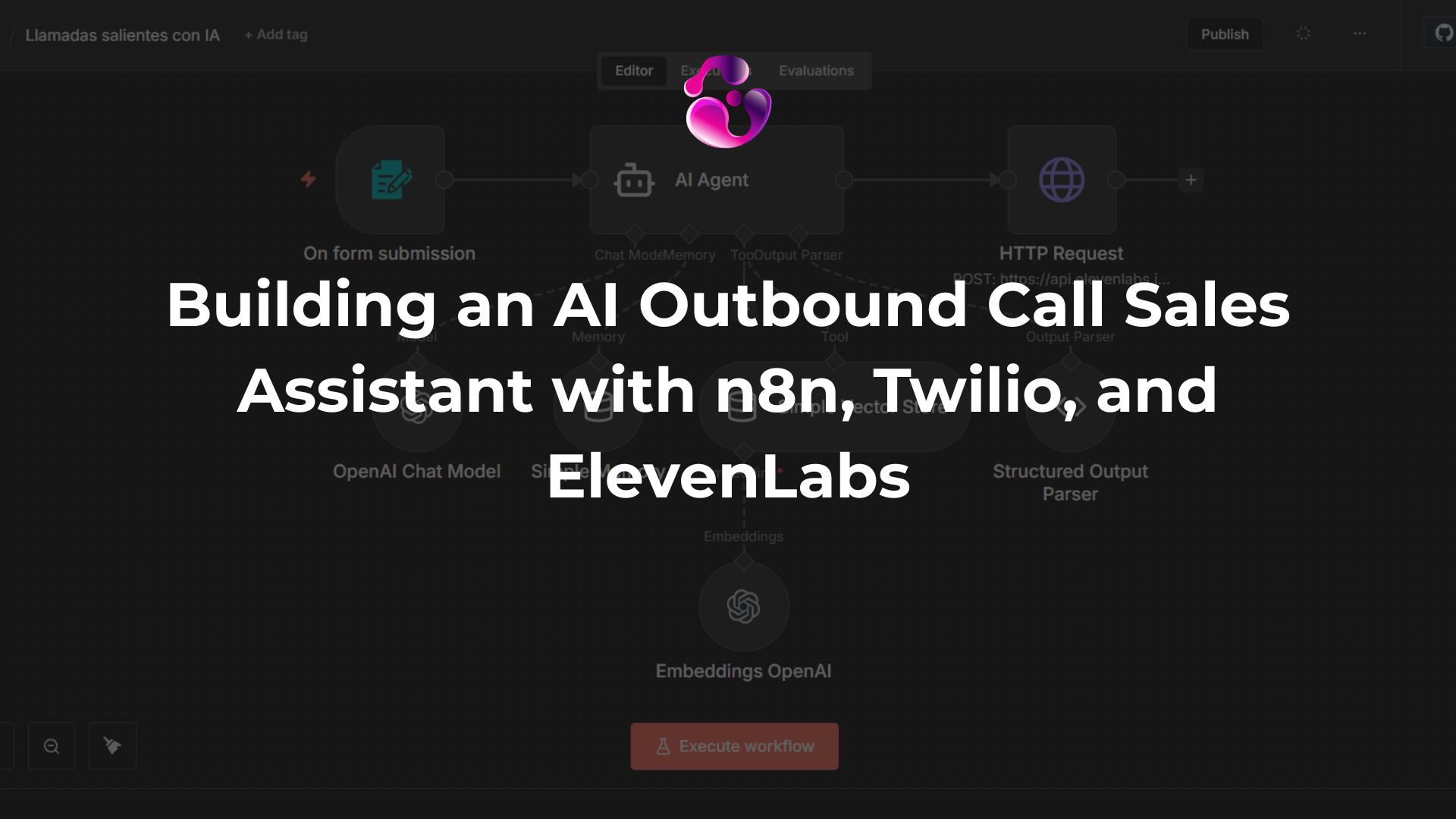
In this article, I break down a production-oriented AI outbound call assistant built using n8n, Twilio, OpenAI, and ElevenLabs.
This is not a demo.
It is a system designed to handle real calls, real users, and real constraints.
All examples and architectural decisions are based on the implementation shown in the original video.
What the System Does
At a high level, the system:
- Receives a lead from a contact form or campaign
- Pre-qualifies intent and context using an AI agent
- Checks available inventory using vector search
- Places an outbound phone call automatically
- Conducts a natural sales conversation in Spanish
- Handles objections, alternatives, and follow-ups
- Logs and transcribes every call for review
I would like to note that this is not about replacing sales teams. It is about filtering, qualifying, and scaling first contact without burning human time.
Core Architecture Overview
The system is built around a clear separation of responsibilities.
1. n8n as the Orchestration Layer
n8n acts as the backbone of the system.
It is responsible for:
- Triggering workflows when a form is submitted
- Passing structured data between services
- Managing agent memory and tools
- Enforcing deterministic output formats
This is critical. Voice systems break when orchestration is sloppy.
2. Twilio for Telephony Infrastructure
Twilio handles:
- Phone number provisioning
- Outbound call execution
- Carrier-level reliability
A key production insight: number locality matters.
Calling Argentina from a US number can cost 30x more per minute than using a local number. These decisions directly impact margins and scalability.
3. OpenAI for Reasoning and Context
OpenAI is used for:
- Lead interpretation
- Intent extraction
- Inventory reasoning
This is not ChatGPT. This is API-driven, constrained, deterministic usage.
Temperature is kept low.
Token usage is controlled.
Hallucination risk is explicitly managed.
4. ElevenLabs for Voice AI and Conversation
ElevenLabs handles:
- Speech-to-text
- Text-to-speech
- Real-time conversational flow
- Voice selection and language control
The voice AI agent receives:
- Lead name
- Intent
- Filtered inventory
- Pre-generated opening message
This keeps the voice agent focused and predictable.
Why Inventory Is Vectorized
Instead of querying rows in a spreadsheet, the inventory is vectorized and queried semantically.
This enables:
- Flexible matching when exact products are unavailable
- Natural alternatives without brittle logic
- Simpler prompts and less conditional branching
For example:
If a Toyota Corolla is unavailable, the agent can suggest a Yaris or Etios without explicit rules.
This is a classic RAG pattern applied to sales, not chatbots.
Guardrails and Output Contracts
One of the most important production decisions is enforcing output structure.
The AI agent is required to return:
- Name
- Phone number
- Call reason
- Opening message
- Inventory snapshot
This structured output is what feeds the voice agent.
Without this contract:
- Calls become inconsistent
- Debugging becomes painful
- Scaling becomes risky
Cost, Latency, and Model Trade-offs
This system is intentionally conservative.
Examples:
- Smaller, cheaper models where possible
- Deterministic temperature settings
- Limited memory windows
- Controlled token budgets
A cheaper model with lower latency is often better than a “smarter” one that introduces instability.
In voice, predictability beats intelligence.
What This System Is and Is Not
It is:
- A scalable pre-sales and qualification layer
- A way to reduce human workload
- A system that respects production constraints
It is not:
- A replacement for closers
- A magic AI salesperson
- A no-maintenance solution
Voice AI amplifies bad decisions faster than good ones.
Final Thoughts
AI outbound calling is not about tools.
It is about architecture, constraints, and trade-offs.
If you treat it like a demo, it will fail in production.
If you design it like infrastructure, it becomes leverage.
The step-by-step implementation can be found in my YouTube video. The full code, including workflows and prompts, can be found on my GitHub repo.
Building something like this on Twilio? I help companies design and run these systems in production. Explore my Twilio consulting and development services.
Find out what your communication setup is costing you.
Get the communication audit