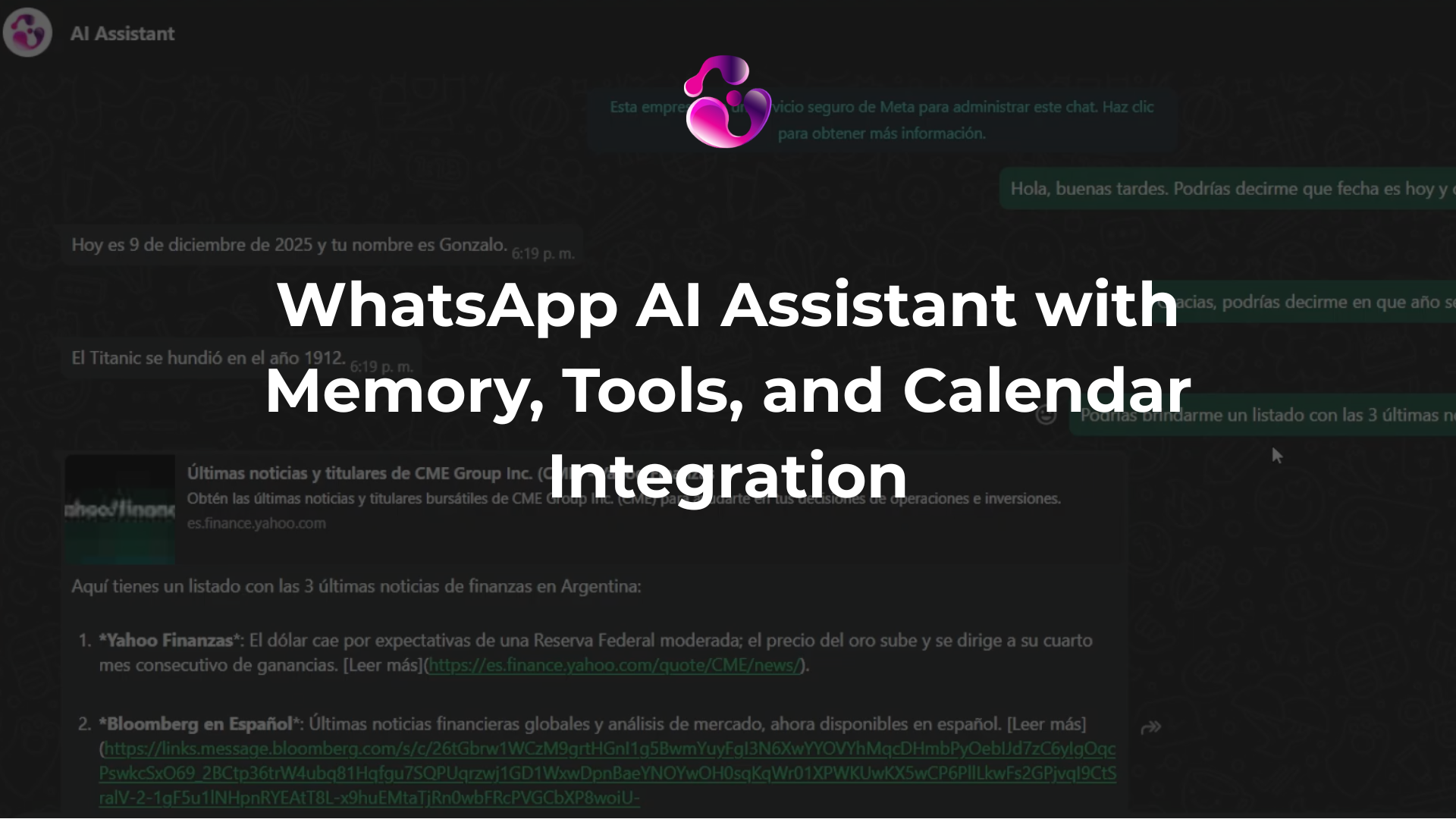
Category: AI Communication Systems
Channel: WhatsApp
Stack: Python, FastAPI, Twilio, OpenAI, LangChain, PostgreSQL, Google Calendar API
The Problem
Most “WhatsApp AI assistants” fail for predictable reasons.
They rely on:
- Static prompt logic
- No persistent memory
- Hardcoded flows disguised as AI
- Zero integration with real business systems
The result is a chatbot that answers questions but cannot operate inside a business context.
This project was designed to test a different approach:
an AI assistant that behaves like an operator, not a FAQ layer.
The Goal
Build a production-oriented WhatsApp assistant capable of:
- Maintaining conversational memory across sessions
- Deciding when to act vs. when to respond
- Executing real operations inside external systems
- Operating under real-world constraints (latency, reliability, provider limits)
This was not about building a demo. It was about validating architectural decisions that hold under real usage.
System Capabilities
The assistant can:
- Remember user-specific context across conversations
- Answer contextual questions without external calls
- Perform live web searches when internal knowledge is insufficient
- Create, read, and delete Google Calendar events
- Accept both text and voice messages
- Transcribe audio inputs before reasoning
- Respond in the user’s language automatically
All interactions are handled through WhatsApp.
Architecture Overview
At a high level, the system is composed of four layers:
- Channel Layer
WhatsApp messaging handled via Twilio to abstract Meta’s API complexity and reduce maintenance overhead. - API Layer
A FastAPI backend designed for event-driven workloads and low-latency webhook handling. - Agent Layer
A LangChain-based agent with:- Explicit tool definitions
- Strict system instructions
- Controlled reasoning and output format
- Deterministic behavior where required
- State & Memory Layer
PostgreSQL used as a checkpoint store to persist conversation history and agent state across sessions.
This separation allows each layer to evolve independently without breaking the system.
Key Design Decisions
1. Twilio Instead of Meta’s Direct API
This was not a convenience choice.
Using Twilio:
- Simplifies WhatsApp onboarding
- Abstracts provider-level noise
- Enables reuse across SMS and voice channels
- Reduces long-term operational risk
For businesses, this translates into lower maintenance cost and faster iteration.
2. Agent-Based Architecture Instead of Scripted Flows
The assistant is not a decision tree.
It:
- Interprets intent
- Decides whether a tool is required
- Executes the tool
- Incorporates the result into the response
This is what allows calendar management and web search to coexist naturally in the same conversation.
3. Persistent Memory via Database Checkpointing
Conversation state is stored in PostgreSQL using LangChain’s checkpoint mechanism.
This enables:
- True continuity across messages
- Safe recovery after restarts
- Predictable behavior under load
Without this, the assistant would degrade into stateless replies.
4. Explicit Constraints in System Instructions
The agent is deliberately constrained to:
- Avoid verbose reasoning
- Output only plain text
- Ask for clarification when required
- Use tools only when necessary
These constraints exist because WhatsApp is not a playground environment. Every response has cost, latency, and UX implications.
What This Project Aims to Prove
This implementation demonstrates that:
- AI assistants can operate inside real communication channels, not just demos
- Tool-augmented agents are viable when properly constrained
- Memory must be treated as infrastructure, not a prompt feature
- Most failures in AI assistants are architectural, not model-related
It also highlights where not to use AI:
- When deterministic workflows are sufficient
- When latency budgets are extremely tight
- When tool execution cannot be safely constrained
Why This Matters for Real Businesses
If you are handling:
- Customer communication at scale
- Appointment scheduling
- Multi-language interactions
- High-context conversations
Then the difference between a chatbot and an AI communication system is not cosmetic. It determines reliability, cost, and trust.
This project exists to make those trade-offs explicit.
Implementation Walkthrough
A full technical walkthrough of the implementation, including:
- Architecture rationale
- Tool definitions
- Memory handling
- Deployment flow
is available as a long-form video.
Relevant Use Cases
- Service businesses with appointment-heavy workflows
- Teams replacing human-first WhatsApp ops gradually
- Founders evaluating AI assistants beyond surface-level demos
- Technical teams needing a reference architecture
Conclusion
The reason I built this assistant from scratch was to show people how can we adapt to new technologies and make good use of its full power with the right setup and architecture. A combination of WhatsApp + AI can become a personal assistant, a customer support's first point of touch and reduce the team's overhead, and you can even scale up across different channels. AI is here to stay and businesses who don't adopt it will be left behind.
Find out what your communication setup is costing you.
Get the communication audit